The New Cold War Is Written in Silicon: The US-China AI Struggle
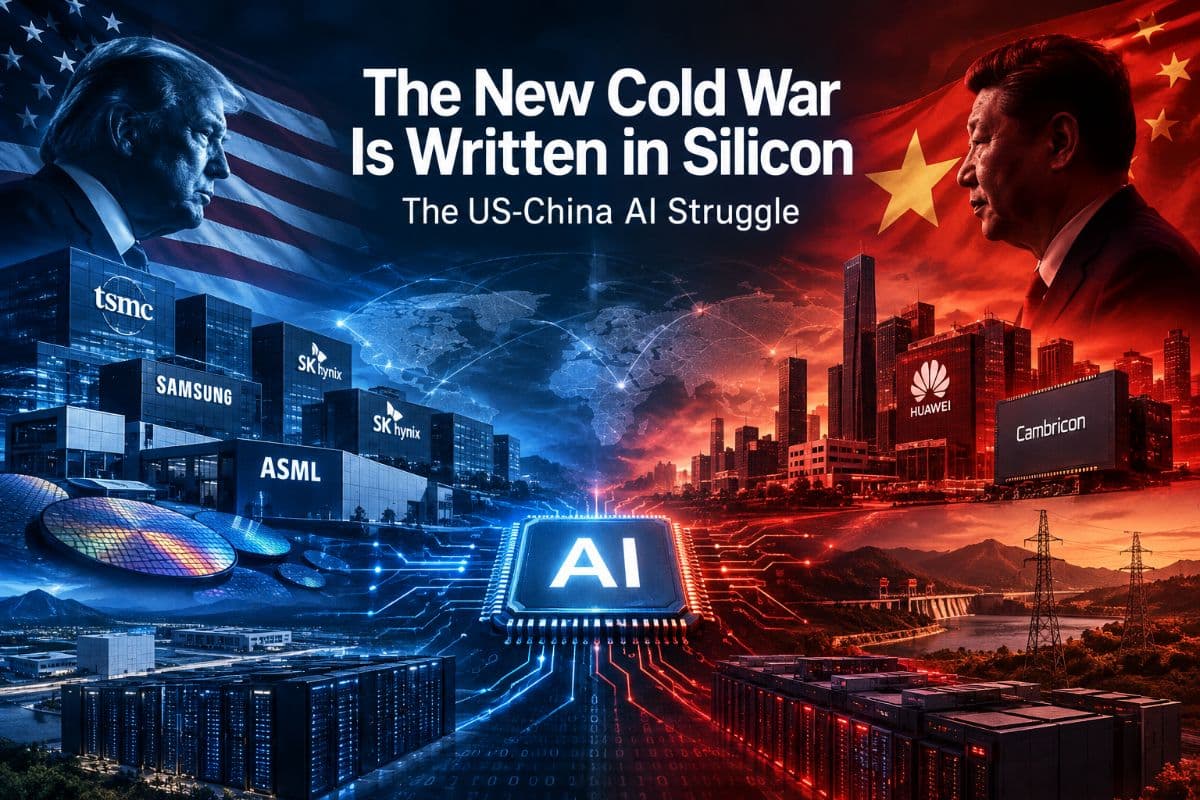
The New Cold War Is Written in Silicon: The US-China AI Struggle
There is a temptation to describe the competition between the United States and China over artificial intelligence in the language of a race — a single finish line, a single winner. The reality unfolding in 2026 is messier and more interesting: two systems pursuing AI dominance through fundamentally different strategies, each with real strengths and real vulnerabilities, locked in a contest whose outcome nobody can yet call.
Two Theories of Victory
Washington's strategy rests on a simple premise: control the chokepoint. Advanced AI models are built on advanced semiconductors, and for now, the United States and its allies — Taiwan's TSMC, South Korea's Samsung and SK Hynix, the Netherlands' ASML — sit atop that supply chain. By restricting China's access to the most powerful chips, the thinking goes, Washington can keep Beijing perpetually a generation behind.
Beijing's strategy is the mirror image: pursue a "full-stack" build-out — chips, compute infrastructure, foundation models, and applications — that reduces dependence on any single foreign input, even if that means running on less powerful hardware.
Both strategies are working, to a point, and both are running into limits.
The Chip Gap Is Real — But Narrower Than It Looks
On raw hardware, the American advantage remains substantial. Chinese AI companies, particularly startups, lack the compute scale of their American competitors because of U.S. export controls on cutting-edge chips, along with the lower performance and availability of domestic Chinese alternatives. Independent estimates suggest that even in generous scenarios for Chinese access, the US could hold somewhere between a 21-to-49-times advantage in AI compute produced in 2026, and that China's advanced chip production capacity is expected to be roughly 1-2% of US capacity in 2026.
Yet Chinese chipmakers are scaling fast on a relative basis. Cambricon reportedly plans to deliver 500,000 AI accelerators in 2026, largely manufactured domestically, and Huawei's Ascend line continues to mature even as its most advanced domestic process nodes lag. Meanwhile, American policy itself has been anything but a straight line. Washington oscillated within a matter of months from tightening controls to loosening them: a January 2026 rule relaxed restrictions on Nvidia H200 and equivalent AMD chips while simultaneously imposing a 25% tariff on advanced AI chips and moving from blanket denial to case-by-case licensing. Analysts have called the resulting framework incoherent — a product not of a single strategic vision but of a three-way tug-of-war between Congress, the executive branch, and a chip industry eager not to lose the Chinese market outright.
Critics on both the hawkish and skeptical ends of the debate have seized on this incoherence. Some argue the controls should be tightened further: the case for any chip sales to China, they contend, rests on modest commercial upside for a handful of companies against the risk of accelerating Chinese military AI capability. Others argue that export controls, however tight, are not by themselves a winning strategy — that denial strategies buy time rather than permanent advantage.
Software Leads, Efficiency Follows
If hardware still favors Washington, the picture is less lopsided on the model layer. China's top AI models continue to lag behind American frontier systems by several months or more, with American models maintaining a lead across benchmarks from math and reasoning to code generation and long-horizon agentic tasks. But Chinese labs have repeatedly demonstrated that compute constraints can be engineered around rather than simply endured. DeepSeek's emergence became a case study in this: facing hardware limits, researchers built custom multi-GPU communication protocols to compensate for slower interconnects, squeezing more capability out of less powerful chips. That kind of constraint-driven efficiency innovation has become a recurring motif of the Chinese approach — and a genuine source of anxiety in Washington, since it suggests the chip gap may matter less over time if fewer chips are needed to reach comparable capability.
There's also a case that chips were never the whole story. One view holds that the deeper bottleneck on both sides is electricity — the ability to power ever-larger data centers — and that China's energy abundance has provided the runway for the kind of experimentation that produces efficiency breakthroughs, even as America's own infrastructure buildout strains against grid and permitting constraints. On this reading, the AI race may not resolve into a single winner at all, but fragment into regional competitions: American firms dominating compute-abundant, cloud-scale inference, and Chinese firms leading in efficiency-constrained applications where power availability offsets chip limitations.
A Contest Without a Finish Line
What makes this rivalry distinct from earlier technology competitions is how directly it has been framed in civilizational terms by both governments. Congressional hearings now carry titles like "China's Campaign to Steal America's AI Edge." Chinese state planning documents set explicit 2030 AI leadership targets. Commentators reach, understandably, for Cold War analogies — a technological arms race in which chips function the way missile counts once did, and where a Sputnik-style shock could reorder the entire policy conversation overnight.
But the analogy has limits. Unlike the Cold War's largely separate technological ecosystems, US and Chinese AI development remain deeply entangled — through global supply chains, through talent flows, through open-source models that cross borders with a single download. Export controls can slow diffusion; they cannot fully sever it. And the policy churn inside Washington itself — tightening, loosening, tightening again — suggests that even the "containment" side of the contest is still discovering what containment means for a technology this fluid.
What seems clear is that neither side is close to a decisive, lasting advantage. The United States retains a real edge in frontier model capability and in the compute that trains it. China retains a real capacity to innovate under constraint and to scale domestic alternatives faster than most forecasts anticipated. The struggle over AI, in other words, isn't heading toward a single dramatic conclusion — it's settling into a long, contested equilibrium, fought out one export license, one model release, and one power-grid expansion at a time.