The Chinese EV Gateway: How Hungary Became Beijing’s Bridgehead Into Europe
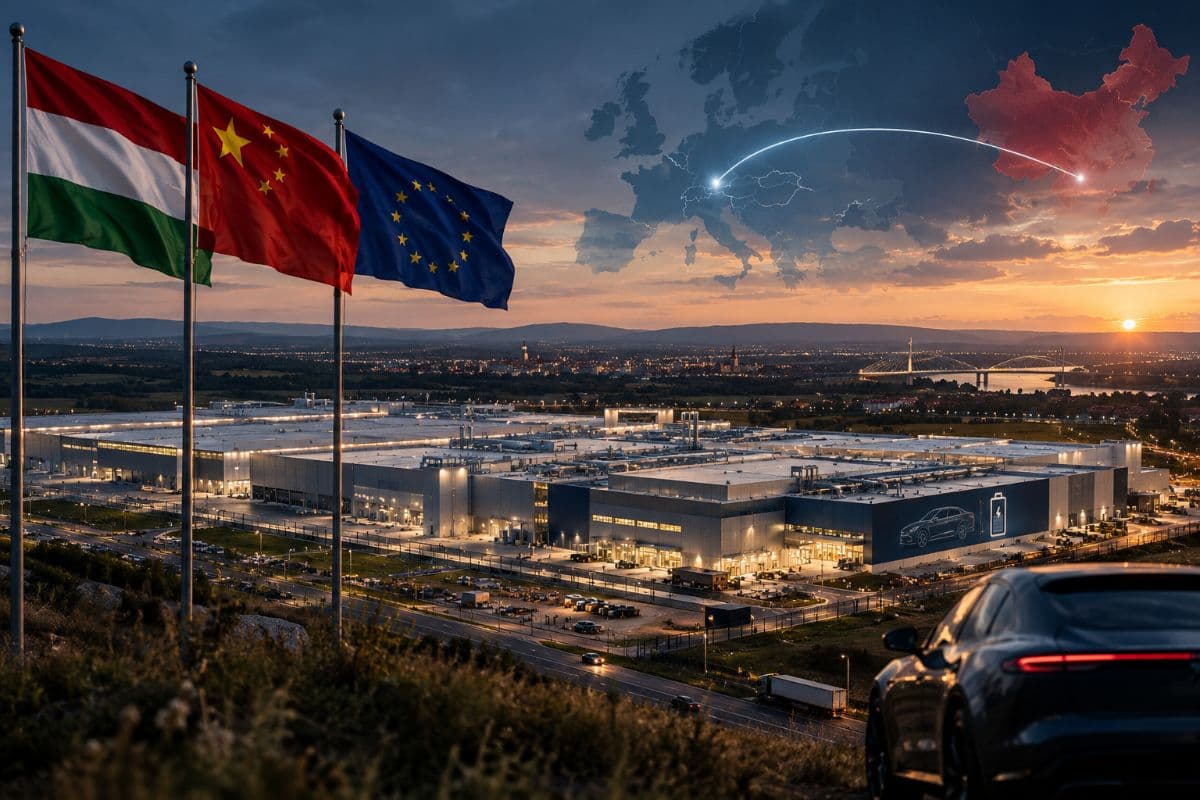
Hungary Becomes China’s Gateway to Europe’s EV Future
While Brussels debates tariffs on Chinese electric vehicles, Budapest is rolling out the red carpet. Hungary has positioned itself as China’s primary gateway to the European Union for EV and battery manufacturing, anchored by two mega-projects: CATL’s battery gigafactory in Debrecen and BYD’s first European passenger car plant in Szeged. This is not merely industrial policy. It is a geopolitical alignment, backed by billions in Chinese capital, strategic infrastructure, and a government willing to defy Brussels to secure it.
The Money: Billions in Chinese Capital
The scale of the investment is staggering for a country of under 10 million people. CATL, the world’s largest battery maker, has committed €7.3 billion (approximately $8.55 billion) to its Debrecen plant, designed for an annual capacity of 100 gigawatt-hours and a workforce of 9,000 once fully operational. The facility is intended to surpass CATL’s existing European site in Thuringia, Germany, and supply major automakers including BMW. The company raised $4.6 billion in its Hong Kong stock exchange debut in May, which helped fund the Hungarian project.
BYD’s Szeged plant represents a similar scale of commitment. Estimates for the investment range from €5 billion to approximately $4.75 billion in construction costs, with the facility designed to produce 200,000 vehicles annually and employ up to 10,000 workers at full capacity. The plant occupies 300 hectares and began trial production in early 2026.
Hungary has become the single largest recipient of Chinese FDI in Europe. In 2025, Chinese direct investment in Hungary reached €3.9 billion, nearly a quarter of the European total. In 2023, 44% of all Chinese investment entering Europe flowed into Hungary; the following year, that figure was still 31%—more than the combined shares directed to France, Germany, and the United Kingdom.
The Infrastructure: Railways, Land, and Logistics
This investment is not occurring in a vacuum. It is supported by hard infrastructure that serves both commercial and strategic purposes. The flagship project is the Budapest–Belgrade railway, a Belt and Road Initiative undertaking jointly built by China, Hungary, and Serbia. The Hungarian section alone cost an estimated €2.5–2.7 billion, financed largely through loans from China’s Export-Import Bank. Beijing covered roughly 85% of the project through 20-year loans—$1.8 billion to Hungary and $1.3 billion to Serbia. The railway reduces travel time between the two capitals from eight hours to three and a half, a major boost for logistics companies moving goods between Chinese factories in Hungary and ports in Greece.
In Debrecen, the infrastructure story is even more directly tied to the battery plant. CATL required the use of a local railway line for its own logistics, leading to the closure of a busy passenger rail route—the 106 railway—which runs through land earmarked for the factory’s expansion. A new railway crossing is being built between the CATL factory and a logistics hall operated by its partner, INPARK, to facilitate freight movement. The industrial park south of Debrecen airport is being redeveloped specifically to accommodate the battery supply chain, with the existing railway retained as a freight line serving the new factories.
The Geopolitics: Orbán’s Eastern Opening
Hungary’s embrace of Chinese capital is the centerpiece of Prime Minister Viktor Orbán’s “Eastern Opening” doctrine, a strategic pivot launched over a decade ago to reduce dependence on Western investment and expand Hungary’s room for maneuver in a multipolar world. Hungary was the first EU member state to join the Belt and Road Initiative and joined the Asian Infrastructure Investment Bank in 2017. Bilateral trade with China rose 11.4% in the most recent year, reaching $16.2 billion.
This strategy has placed Hungary at the center of a growing geopolitical contradiction. Brussels has imposed tariffs of up to 38% on Chinese EVs, citing unfair state subsidies. Hungary voted against those tariffs and has been outright opposed to them. Orbán has described the measures as a “brutal” punishment and warned that Europe’s turn toward economic protectionism would destroy the EU’s economy. Germany, Malta, Slovakia, and Slovenia joined Hungary in voting against the tariffs, while France and nine other countries voted in favor.
The Risks: Dependence, Politics, and Execution
The bet is not without significant risks. Critics warn that Hungary is becoming overly dependent on Chinese capital and technology at a moment when the EU is actively trying to “de-risk” its supply chains. The EU is scrutinizing state aid and foreign subsidies, and any future crackdown on Chinese content could undermine Hungary’s export model. There are also concerns about transparency: Hungary’s new government has alleged that the previous administration under Orbán committed undisclosed state support to the BYD deal, and a review of Chinese investments is underway.
Domestically, the projects face execution challenges. CATL’s Debrecen plant has faced delays, and the original site plan for three construction phases has been scaled back—the first phase alone represents only one-third of the originally planned volume. Environmental concerns are mounting: battery plants are water- and energy-intensive, and local communities have raised questions about permits, infrastructure strain, and labor shortages. Allegations of forced labor involving Chinese workers at BYD’s Hungarian operations have also surfaced, adding a human rights dimension to the investment.
What to Watch
Two factors will determine whether Hungary’s gamble pays off. First, EU tariff and local-content rules: if Brussels tightens the screws on Chinese content in batteries and vehicles, Chinese firms may slow or shift their plans. Second, execution: CATL and BYD must actually ramp up production, hire workers, and secure permits on schedule. For now, Debrecen and Szeged are where the geopolitics and economics of electrification collide—and where China’s European future is being built, one factory and one railway at a time.