The Game-Changers in the Sky: Why Russia's Geran-4 and Geran-5 Are Reshaping the Ukraine War
The Game-Changers in the Sky: Why Russia's Geran-4 and Geran-5 Are Reshaping the Ukraine War
For two years, Ukraine's air defense strategy against Russian kamikaze drones rested on a simple calculation: the propeller-driven Shahed-136 (rebranded by Moscow as the Geran-2) was slow enough — roughly 180 km/h — for cheap interceptor drones and mobile fire teams to hunt down. That calculation is now obsolete.
Russia has deployed two new jet-powered variants — the Geran-4 and Geran-5 — that are three times faster, carry heavier warheads, and are overwhelming the very systems Kyiv built to defeat their predecessors. This is not an incremental upgrade. It is a fundamental shift in the air war.
What Are These Drones?
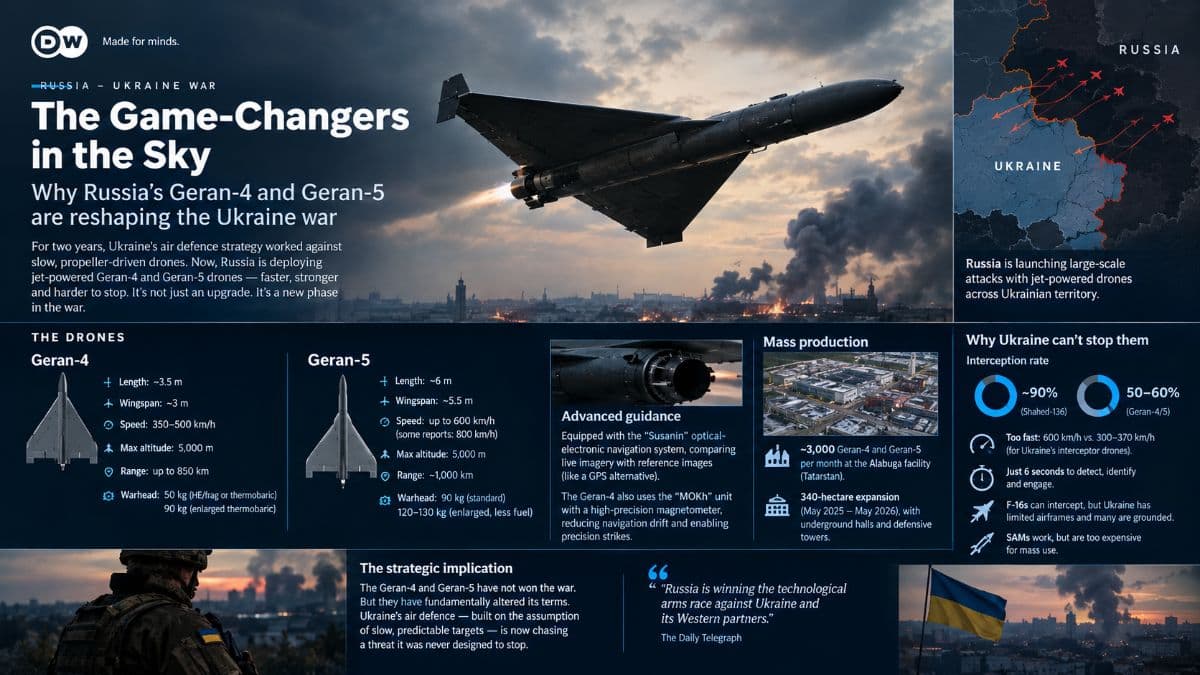
The Geran-4 retains the familiar Shahed silhouette — about 3.5 metres long with a 3-metre wingspan — but underneath, it is a completely different machine. It features a reinforced airframe, a Chinese-designed turbojet engine producing 160 kgf of thrust, and the ability to manoeuvre under high G-loads. Its cruising speed ranges from 350 to 500 km/h, with a maximum altitude of 5,000 metres and a range of up to 850 kilometres. It can carry a 50 kg high-explosive fragmentation or thermobaric warhead, or an enlarged 90 kg thermobaric variant.
The Geran-5 is an entirely different beast. At approximately six metres long with a 5.5-metre wingspan, it resembles a cruise missile more than a drone. Powered by a larger Chinese Telefly TF-TJ2000A turbojet engine, it reaches speeds of up to 600 km/h — with some reports suggesting 800 km/h — and a declared range of about 1,000 kilometres. Its standard 90 kg warhead can reportedly be increased to 120–130 kg at the expense of fuel capacity.
Both drones are equipped with the "Susanin" optical-electronic correlation navigation system, which compares live camera imagery against pre-loaded reference images to guide the drone to its target without GPS. The Geran-4 also incorporates the "MOKh" unit with a high-precision magnetometer, reducing inertial navigation drift and enabling precision strikes against bridges and power line supports.
The Production Reality
This is not a boutique weapons programme. Russia produces approximately 3,000 Geran-4 and Geran-5 drones per month at the Alabuga facility in Tatarstan — a figure that has already surpassed production of the older Geran-2. Satellite imagery confirms a 340-hectare expansion of the site between May 2025 and May 2026, with underground production halls and defensive towers under construction to protect against Ukrainian strikes.
The implication is stark: Russia is not merely deploying a handful of advanced prototypes. It is mass-producing jet-powered strike drones at a rate that allows for sustained, large-scale attacks.
Why Ukraine Cannot Stop Them
The numbers tell the story. Against the older Shahed drones, Ukraine's interception rate had reached approximately 90%. Against the jet-powered Gerans, that figure has collapsed to 50–60% — and in some periods, even lower.
The core problem is physics. A drone flying at 600 km/h gives defenders roughly six seconds to detect, identify, and engage. Ukraine's workhorse interceptor drones — the Sting, STRILA, and similar platforms — have maximum speeds of 300–370 km/h. They simply cannot catch a Geran-5 in a tail chase.
Ukraine's alternatives are limited and costly. F-16 fighters can intercept them — and have downed over 2,500 Russian drones in two years — but Ukraine has a limited number of airframes, and many are grounded for repairs. AI-guided machine gun turrets have shown promise, but their coverage is limited. Surface-to-air missiles work, but each interception costs far more than the drone being destroyed — an economically unsustainable exchange rate when Russia is launching 77 jet-powered drones in a single night.
The Strategic Implication
The Daily Telegraph was blunt in its assessment: Russia "is winning the technological arms race" against Ukraine and its Western partners. The Geran-4 and Geran-5 are the clearest evidence of that claim.
Ukraine is racing to field its own jet-powered interceptors — the Alexa Spatium has entered service, and Germany's Quantum Systems plans to supply tens of thousands of SPYS interceptors — but mass production is still months away. By the time these systems arrive in numbers, Russia may have further evolved the Geran platform, potentially adding air-to-air missiles to shoot down Ukrainian interceptors, or increasing speeds beyond 700 km/h.
The Geran-4 and Geran-5 have not won the war. But they have fundamentally altered its terms. Ukraine's air defense — built on the assumption of slow, predictable targets — is now chasing a threat it was never designed to stop.